


Which Products Are Best Suited for Shelf Plate Freezers?
In the food processing industry, selecting the right freezing equipment requires more than considering its freezing capacity. Factors such as product shape, size, thickness, packaging format, and final freezing quality requirements must also be taken into account. Different food products have varying requirements for heat transfer efficiency, freezing uniformity, and shape preservation during the freezing process.
A shelf plate freezer is a contact-type industrial freezing system that transfers cooling through multiple horizontal evaporator plates. It offers high freezing efficiency and consistent product shape, making it widely used in food processing applications.
This equipment is commonly used in food processing plants to freeze block-shaped or regularly shaped products.
So, which products are best suited for shelf plate freezers? This article examines suitable product categories and packaging methods to help food processing businesses determine whether a shelf plate freezer meets their production requirements.
1. What Is a Shelf Plate Freezer?
A shelf plate freezer is a contact-type quick freezing machine featuring a relatively simple structure and flexible operation. It uses multiple horizontally arranged evaporator plates to achieve efficient and uniform freezing.
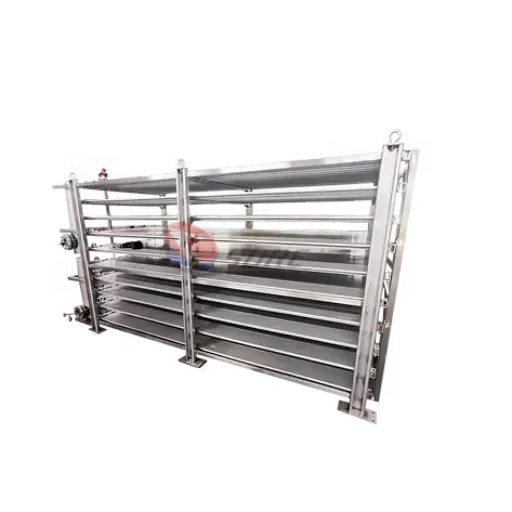
Unlike tunnel freezers, which rely on circulating cold air to freeze products, shelf plate freezers primarily use direct contact heat transfer. Their main features include:
Direct Contact Heat Transfer: Cooling is transferred directly through contact between the plates and the product or its packaging, providing high heat transfer efficiency and consistent freezing performance.
Multi-Layer Structure: The evaporator plates are arranged horizontally in fixed layers. Products are manually loaded onto trays or into molds, which are then placed between the freezing plates. This design accommodates products in different specifications.
Suitable for Batch Freezing: Production can be organized according to product specifications, loading quantities, and freezing cycles.
2. Which Food Products Are Best Suited for Shelf Plate Freezers?
Shelf plate freezers are more suitable for food products that can maintain good contact with the freezing plates, have relatively consistent thicknesses, and do not require complex conveying or agitation during freezing.
1. Block-Shaped Meat and Poultry Products
Common products include frozen beef blocks, pork blocks, lamb blocks, chicken blocks, and minced meat blocks.
2. Seafood and Aquatic Products
Common products include thick-cut fish fillets, fish blocks, compressed shrimp blocks, and shellfish.
3. Prepared and Processed Foods
Common products include formed meat patties, hamburger patties, fish cakes, and other shaped processed foods.
4. Other Foods Suitable for Plate Freezing
Raw material blocks for ready-to-eat foods, as well as packaged fruit and vegetable blocks.
3. Typical Applications That Are Not Suitable for Shelf Plate Freezing
1. Loose Small Particles Requiring Individual Quick Freezing (IQF)
Products such as peas, corn kernels, and diced vegetables require fluidized bed freezers to keep individual pieces separated during freezing. Contact plate freezing cannot achieve this individual separation, which may cause the products to freeze together into clumps.
2. High-Demand Continuous and Automated Production Lines
Shelf plate freezers operate in batches, with products requiring manual or semi-automatic loading and unloading. If a production line requires continuous product conveying and reduced manual handling, tunnel or spiral freezers should also be considered.
4. What Are the Key Factors in Equipment Selection?
For food processing businesses, achieving complete freezing is only a basic requirement. Freezing uniformity across different products within the same batch, as well as between different areas of an individual product, is equally important.
For meat, seafood, and prepared foods in particular, uneven freezing may affect product storage, cutting, packaging, and subsequent processing quality. The following factors should be considered before selecting equipment:
1. Product Thickness Consistency
If products within the same batch have significant thickness variations, thinner products will generally freeze faster than thicker ones. Standardizing product dimensions helps improve freezing consistency across the batch.
2. Contact Between Products and Freezing Plates
Plate freezing relies on heat exchange between the products and the freezing plates. If the bottom surface of a product is uneven, or if excessive air is trapped inside the packaging, air gaps may increase contact thermal resistance and reduce freezing efficiency.
3. Loading Method
Improper product arrangement, localized stacking, or exceeding the designed loading capacity may all affect actual freezing performance.
5. When Should You Prioritize a Shelf Plate Freezer?
If most of the following conditions apply, a shelf plate freezer should be included among your preferred equipment options:
Products are regular block-shaped, tray-packed, or formed and packaged in containers, allowing them to be positioned securely between the freezing plates.
Product thicknesses and specifications within the same batch are relatively consistent, and individual separation through airflow or fluidization is not required.
Production is primarily organized around batch freezing.
6. Choosing the Right Plate Freezing Solution for Your Products
Sure International specializes in food processing, industrial freezing, and cold chain equipment solutions. Based on different product shapes, dimensions, packaging methods, and production requirements, Sure International can provide recommendations for suitable freezing equipment configurations.
If you are looking for industrial plate freezing equipment for block-shaped meat, seafood, or prepared food products, feel free to get in touch.
Our team can help evaluate equipment configurations, freezing cycles, and suitable solutions based on your actual products and production capacity requirements.


